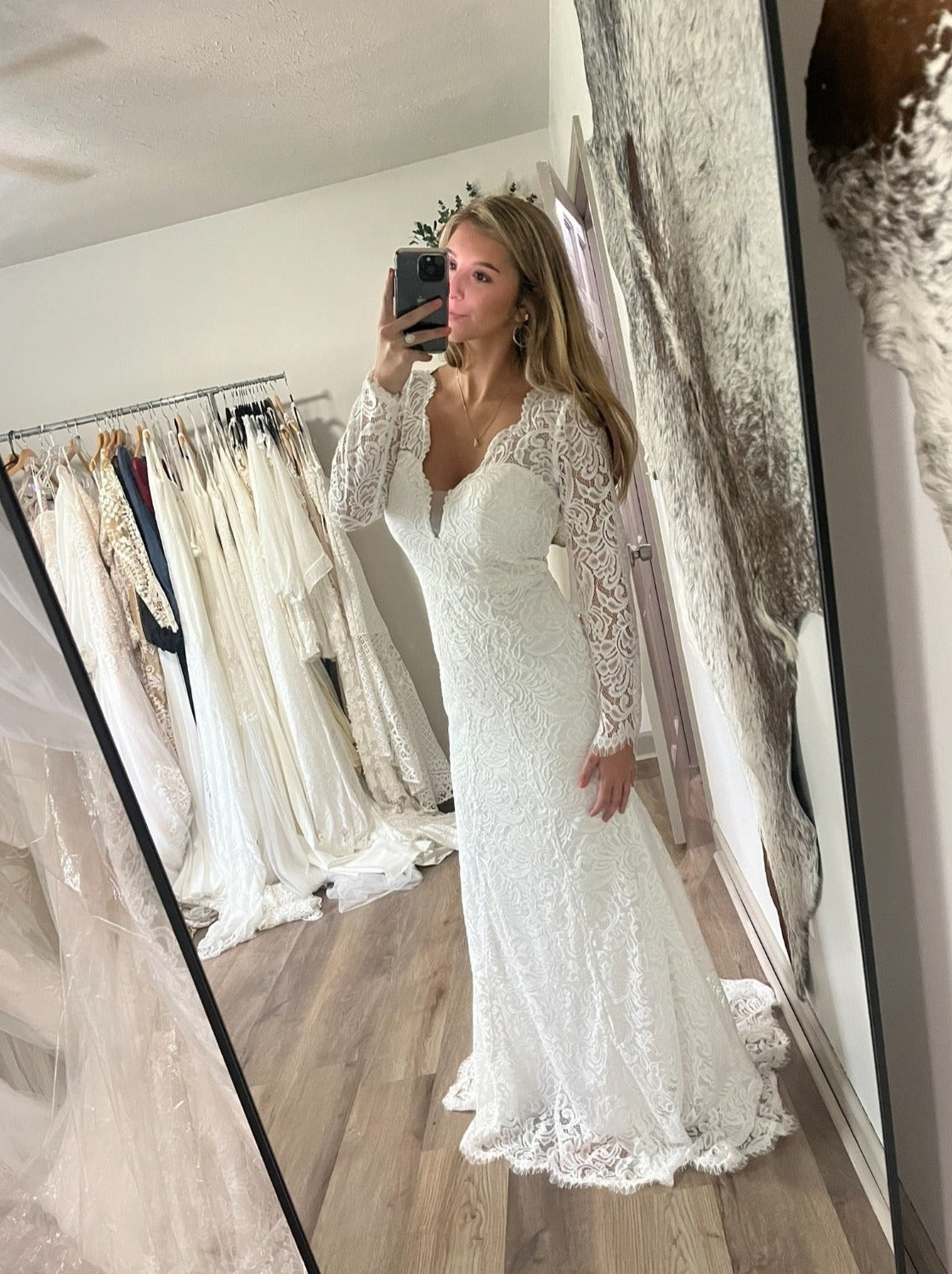
SKU: 55511033337
sample bridal dresses

sample bridal dresses At Home Sample Gown Try On, *click, and select from the list below, do – A Western Wedding Co

Sale price$26.29 Regular price$29.21
Save 10%
Size: 4

Pay in installments of $7.30 with ShopPay, AfterPay and Klarna

Shipping Estimate
USA
  • USA
  • CAN

Ships within 48 hours · Estimated delivery Jul 19 - Jul 24

Promo Codes Available:

For Your Every Summer RSVP, with Code: SUMMER15

Description

sample bridal dresses At Home Sample Gown Try On, *click, and select from the list below, do – A Western Wedding Co***Select from the list below, DO NOT use the checkout option above.*** Want to try on one of our gowns from the comfort of your home? Now you can! We are offering at home sample gown try ons! *as a general rule if you are within 2 sizes of the sample gown, you can use the sample to get a good idea of how the gown will fit, look and sizing* For each try on you will receive Sample gown of choice Prepaid return shipping label Customizations note page to

***Select from the list below, DO NOT use the checkout option above.***

Want to try on one of our gowns from the comfort of your home? Now you can! We are offering at-home sample gown try-ons!

*as a general rule if you are within 2 sizes of the sample gown, you can use the sample to get a good idea of how the gown will fit, look and sizing*


For each try on you will receive...

-Sample gown of choice

-Prepaid return shipping label

-Customizations note page to return with the gown (this applies only if the gown is customizable and you choose to purchase your gown of the same style).

- "I said yes" sign

- If you choose to purchase your gown of the same style as the sample you purchased, you will get a $100 refund on your wedding gown purchase.


How it works...

-Select the desired gown and available sample size to rent.

-Review the individual size chart before renting, as we currently have a limited selection of sample sizes. (Depending on the success of the trial period, we may expand our range of available sizes in the future).

-Choose the dates for your gown reservation and proceed to checkout.

-Once payment is complete, you will receive an emailed contract outlining the rental agreement.

-Your rental gown will be shipped to you or placed on a waitlist, and you will be notified via email with a tracking number once your sample has shipped.

-After receiving the gown, you have 3 days to try it on before returning it to us. Simply box it up and drop it off at UPS with the provided shipping label.

-You will only be charged late fees if the gown is not returned using our label and tracking number at the end of the 3rd rental day. The late fee is $50 per day until the retail value of the gown is reached, and it is nonrefundable. Sundays and Federal Holidays are the only exceptions to late fees. 


Fees...

- Late fees will begin if the sample gown has not been shown as in transit back to us by the end of the 3rd rental day. Each day the gown is late is a $50 late fee, or until the full retail value of the gown is reached.

-If the sample gown has not been sent back to us by the end of 30 days since you received the sample gown, you will be charged the full price of the gown.

- If the gown is returned damaged or dirtied you will be charged a cleaning, repair or replacement fee for the sample gown.


Shipping Notes
  • Free Standard Shipping on $100+ Orders to the USA.
  • Except Preorder products are shipped in 48 hours.
  • Delivery to the USA:
  1. Standard Shipping : 3-10 business days
  • If time is of the essence, please consider selecting expedited delivery for faster service.
Exchange/Return Notes
  • We offer a 30-day return/exchange service after receiving.
  • Final sale items are not eligible for returns or exchanges.
  • To process your return/exchange, please contact us at [email protected]
  • Please click here for more details>>> Return & Exchange Policy
SKU: 55511033337

Discover Niche Categories That Outsell sample bridal dresses

Top-Converting Item to Boost Your Average Order

4.8 ★★★★★
Based on 28 reviews
Sort
Highest Rating
Newest First
Oldest First
Product Reviews
P
Verified Purchase
Peter Sorenson
Alexandria, US
★★★★★ 5
The Innovator's DNA - Disruptive Research - Disruptive Writing
A Politically Correct Status Quo It is politically correct in management circles to say that you are "results oriented" or that you "drive for results" in your organization. The status quo in business schools is to indoctrinate students in the delivery skills of analyzing, planning, detail-oriented implementing, and disciplined executing. This book and the research upon which it is based disrupts that politically correct status quo. Clayton Christensen has spent close to two decades creating the research, conceptual, and application foundation of the disruptive innovation body of knowledge. He has been working for more than 8 years with Jeff Dyer and Hal Gregersen, both gifted researchers, teachers, and consultants in their own right, on this project. These guys are a disruptive "dream team" of contributors. This book articulates an extension of the disruptive innovation body of knowledge that clearly describes an individual profile of the disruptive innovator and an organizational profile of an organization that makes disruptive innovation happen. So what makes this book disruptive? The first thing is timing. It arrives on the scene at a time when innovation is one of the most critical components of a solution to our global financial and organizational mess. If we are to get out of our morass of debt and sluggish growth and respond to the continually emerging challenges of a burgeoning global society it will ride on the backs and wings of innovation. The status quo must be disrupted for us to survive and thrive! Second is the audacity of the core models. The authors claim that innovation can be learned at both the individual and organizational level. Individuals can increase their ability to discover (Discovery Quotient - DQ) and learn to be more innovative. They cite the four specific behavioral skills of asking questions, engaging in observations, networking with people who have a different point of view, and experimenting to figure out what can work as the common elements of what innovators do. They also identify the cognitive skill of associational thinking, the ability to find connections between ideas that do not seem to be related to each other, as the connection between the behavioral skills and the generation of ideas. They extend their claim that the innovation competency can be learned to the organizational domain by saying that organizations can become more innovative through developing and leading people, designing and implementing processes, and advocating and living by philosophies that support innovation. These two arguments stand in stark contrast to the beliefs and practices of a vast majority of leaders and institutions. (For a diagram of the Model see [...]) 'And all of this is built upon the third source of disruption: research. Their work is based on well-founded research into the "DNA" of the world's leading innovators and the world's most innovative organizations. The authors conducted nearly 100 interviews of world class innovators and their colleagues to get at the heart of what innovators do. They also interviewed and surveyed executives who are not innovators. (Their survey data base has over 5000 respondents in it.) So they have been able to compare and contrast the two populations to more clearly see what it takes to effectively innovate. They have also done research on business results attributable to innovation. Collaborating with HOLT (a division of Credit Suisse) they were able to craft a measurement called the "innovation premium." This measure identifies if an organization's market capitalization can be accounted for by existing cash flows or if there is an innovation influence on the stock price. By using this measure, they have been able to clearly and objectively identify which organizations are benefiting from innovation. Yet to Explore The tension in the balance of influence and power between the leaders with predominantly "Discovery" or "Delivery" mindsets is an area that has yet to be explored. If the premises of this book are sound, and I believe they are, we need to figure out how to manage that tension and balance in order to generate, incubate, and strengthen innovative ideas as we bring them to full fruition in the marketplace. Great ideas that are not delivered upon are simply recreational pursuits that do not build great people, great institutions, and great societies. So there is work yet to do. Invest Your Time and Effort This book makes a significant contribution to both the disruptive innovation body of knowledge and the evolving body of practice on innovating disruptively. It is well worth reading, pondering, and acting upon.
WAS THIS REVIEW HELPFUL?YesReportShare
Reviewed in the United States on August 18, 2011
A
Verified Purchase
Amazon Customer
Chelsea, US
★★★★★ 5
Inspiring and well-written
This is a very interesting book written by some Harvard profs. They did a large national survey of innovative businesses and their leaders. The book posits that innovative people follow five skills: associating, questioning, observing, networking, and experimenting. These skills can be found at the individual or organizational level. The idea is that most people have these skills in their DNA and can bring them out with some practice. There are a lot of interesting and inspiring examples like Steve Jobs and Jeff Bezos. Although this book seems like a self-help type book with a lot of hype, it has an academic underpinning. Any organization that is interested in promoting innovation could benefit from encouraging these 5 skills. If you are interested in innovation or creativity in business or any organization that produces something, you will like this book. The books is a little distracting to read because it has sidebars all through it giving interesting examples that break up reading concentration. Aside from that, it is a well-written book that is easy and enjoyable to read. I enjoyed the book greatly and found it to be inspiring.
WAS THIS REVIEW HELPFUL?YesReportShare
Reviewed in the United States on December 5, 2015
S
Verified Purchase
Stephen Collins
Massapequa, US
★★★★★ 4
Great read and research. But what about daily application for regular people?
The research piece behind this book might be the next thing I read, as I'm intrigued by the academic rigor applied. The reveal and living examples of the five skills - questioning, networking, experimenting, observing and associating - are tangible and approachable given their articulation through well-known and highly visible entrepreneurs running innovative companies. There's much to be gleaned by looking at the way these people behave and, even through simple emulation, enhancing one's own skills. My only real disappointment with the book is its limited approach to practical, daily application for those not yet at the top of the tree. It's rather a different kettle of fish for the innovation-minded, but stuck in bureaucracy, worker who wants to make things better, is still motivated, and hasn't been crushed by the machine. How does that person actively innovate? And, in some cases, get away with it? This book (or an accompanying volume) focussing on daily, in-work, innovation would be useful.
WAS THIS REVIEW HELPFUL?YesReportShare
Reviewed in the United States on May 23, 2013
A
Verified Purchase
Annette
Houston, US
★★★★★ 5
A Favorite Book on Innovation
Format: Hardcover
Very well written and enough stories to help the true content stick. This is a favorite book of mine and has lead to interesting conversations to boot.
WAS THIS REVIEW HELPFUL?YesReportShare
Reviewed in the United States on September 29, 2025
K
Verified Purchase
Kurt Manwaring
New York, US
★★★★★ 5
An exceptional five stars out of five
Few qualities separate inordinately successful entrepreneurs from the rest of the pack than the ability to innovate. Many have debated whether individuals are born with this quality or whether it can be nurtured. In The Innovator's DNA, Jeff Dyer, Hal Gregersen and Clayton Christensen explain that while genetics play a role, innovation is most certainly a skill that can be learned. In particular, the authors introduce and expound upon five "discovery skills" found in the leaders of some of the most innovative companies in the world: (1) associating, (2) questioning, (3) observing, (4) networking and (5) experimenting. Each discovery skill is accompanied by real-world examples and pragmatic exercises that make the book unusually valuable in an age where copious books on change, leadership and innovation overwhelm the already-overwhelmed executive. I give The Innovator's DNA an exceptional five stars out of five. The authors present a very readable book and provide concrete exercises for developing innovative skills. Using the principles provided in the book, I created a folder on my computer that I call my "Innovation Room." I use this to track progress as I work through various exercises and as I take time to ponder about how to apply innovative solutions to extant problems in Utah. This book was and will continue to be useful to me, and is recommended as a must-read for those interested in adding rare innovative attributes to their arsenal of problem-solving and decision-making skills. *NOTE: The preceding text is taken verbatim from my short book review printed in the June 2012 edition of Utah Business.
WAS THIS REVIEW HELPFUL?YesReportShare
Reviewed in the United States on March 22, 2013

recommand products